If you’ve ever stood next to a running centrifugal air compressor on a hot, humid summer day, you might have noticed something: the unit seems to work a little harder, and sometimes the pressure gauges don’t hit the numbers you’re used to seeing on crisp, dry fall mornings. As a centrifugal air compressor supplier who’s spent years troubleshooting and supporting customers across manufacturing, food processing, and automotive industries, this isn’t just a casual observation—it’s one of the most common, costly, and misunderstood variables that impact compressor performance, efficiency, and longevity. In this post, I’m breaking down exactly how inlet air humidity changes shape the way your centrifugal compressor works, what that means for your operations, and how you can adjust to keep your system running reliably no matter the weather. Centrifugal Air Compressor
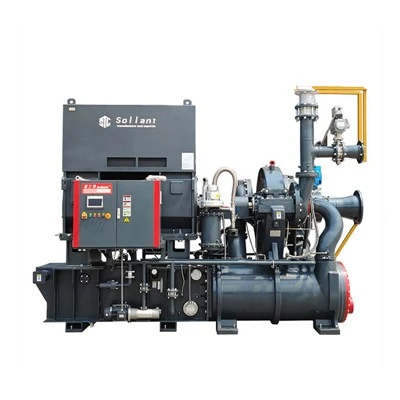
First, let’s start with the basics anyone who’s worked with compressors knows: air isn’t just nitrogen and oxygen. It’s a mixture of gases plus water vapor, and humidity is just the measure of how much of that vapor is hanging in the air. Relative humidity (RH) is what we typically talk about, ranging from 0% (bone-dry desert air) to 100% (saturated, foggy air). When RH hits 100%, air can’t hold any more water, so it condenses into droplets on cool surfaces. Centrifugal compressors work by taking in this air, compressing it rapidly using high-speed impellers, and discharging it at a higher pressure for use in everything from powering pneumatic tools to cooling process systems. The mass of that inlet air—meaning, the actual weight of all the gas and vapor molecules—makes all the difference here.
Here’s the key physics that most people miss: water vapor is less dense than dry air. Dry air has an average molecular weight of about 29 g/mol, while water vapor is just 18 g/mol. When humidity goes up, the total molecular weight of the inlet air drops because lighter water molecules displace heavier nitrogen and oxygen molecules. That may sound small, but over the course of a day, it adds up fast. Let’s do a quick example: at 25°C (77°F) and 100 kPa, 1 cubic meter of dry air weighs ~1.177 kg. If that same air is 80% RH (a typical humid summer day), it only weighs ~1.144 kg—a difference of ~33 grams per cubic meter. For a compressor that pulls in 10 cubic meters of air per second, that’s 330 grams less mass every single second.
Centrifugal compressors are built to move a specific mass of air, not just a specific volume. The impellers and volute casing are sized based on the design mass flow rate the compressor needs to deliver to meet your required discharge pressure. If the inlet air is humid, the lower density means the compressor is moving less mass than it was designed for—even if the volume of air it’s pulling in is exactly what you set. That’s where the first big performance hit comes in: reduced airflow and lower discharge pressure.
I see this with customers all the time during peak summer months. One automotive parts plant I work with outside Houston, Texas, for example, runs their production line around the clock, and their centrifugal compressor is sized to deliver 150 psig of pressure to power robotic welders and paint booth equipment. On a 90°F, 85% RH day, their discharge pressure consistently drops to 135 psig, and the line slows down because the pneumatic tools aren’t powerful enough to operate at their intended speed. When our service team checked the compressor, everything was working fine—no fouled filters, no worn impellers, just higher inlet humidity dragging down performance. The compressor was doing exactly what it was designed for, just with less dense air than its design point.
Beyond pressure drops, humidity also cranks up the compressor’s energy consumption. Because the mass of air being compressed is lower, the compressor has to work longer or spin faster (centrifugal compressors adjust speed via variable frequency drives, or VFDs, to maintain pressure) to get the required mass flow. Compressor work is directly proportional to the mass of gas being compressed, per the polytropic compression equation that’s the foundation of centrifugal compressor design. That means every 1% drop in inlet air density from humidity translates to roughly a 1% increase in specific energy (energy per unit of compressed air). For industrial compressors that run 8,000 hours a year, that’s a massive energy bill increase. A customer with a 500-horsepower centrifugal compressor, for example, can easily add $15,000 to $20,000 in annual energy costs just from summer humidity—enough to fund a full system tune-up or upgrade.
Wait, but isn’t water vapor in the air at least helpful sometimes? Short answer: no, not for the compressor itself. In fact, high humidity can also cause problems with condensation inside the compressor and downstream systems, which can damage equipment and contaminate your product. When air is compressed, its temperature rises rapidly, and hot, humid air has to shed that heat. As the compressed air cools, the water vapor it carried in condenses into liquid water. If that condensate isn’t removed properly, it can build up in the compressor’s intercoolers, aftercoolers, and air receivers. For the compressor, that means additional load: the liquid water is denser than air, so it adds extra mass the impellers have to move, and it can cause corrosion inside the casing and impellers over time. For food and beverage customers, that condensate can contaminate finished goods, leading to product spoilage or costly recalls. One craft brewery I work with in the Pacific Northwest had to shut down their canning line for three hours last year because condensed water from their humid inlet air got into their compressed air system and made contact with the beer, ruining 2,000 cans of IPA. The root cause? They didn’t account for high humidity when sizing their dryer system, so they couldn’t remove the excess water before it reached the line.
Another less obvious impact of inlet humidity is surging—a phenomenon that’s the biggest enemy of centrifugal compressors. Surging happens when the compressor’s mass flow drops below a minimum threshold, causing the flow to reverse back through the impeller, creating violent pressure spikes and vibration that can damage seals, bearings, and even the impeller itself. How does humidity play into this? When inlet air density is lower, the compressor’s surge point shifts. Surge is a function of the compressor’s inlet volume flow, but since humidity reduces density, the mass flow needed to avoid surge is lower—but so is the compressor’s ability to deliver pressure at that mass flow. On hot, humid days, the compressor often operates closer to its surge line because it’s working at a lower mass flow, increasing the risk of unplanned downtime. I once worked with a metal stamping plant that had a surge event that took their compressor offline for 12 hours during a busy season, costing them over $50,000 in lost production. The root cause? They hadn’t adjusted their compressor’s control setpoints for summer humidity, so it was running too close to surge.
So, what can you do about this? The good news is there are actionable steps to mitigate the impact of inlet humidity, and as a supplier, we work with customers to tailor solutions to their specific operations. The first step is always to measure your inlet air conditions consistently. Most plants only check pressure and discharge flow, but adding simple sensors for inlet temperature and relative humidity (or dew point, a more precise measure of moisture content) lets you calculate actual inlet air density and adjust compressor operation accordingly. Many modern centrifugal compressors have built-in control systems that can be programmed to adjust speed or load based on real-time humidity and density data, automatically compensating for lower mass flow on humid days.
Next, optimizing your inlet air system can make a huge difference. If your compressor is pulling air from inside a hot, stuffy equipment room, that air is likely more humid and less dense than air pulled from outside at a lower temperature. Relocating the inlet duct to pull cool, dry outside air (or air from a shaded, well-ventilated space) can raise inlet density by 5-10% on average, reducing the impact of humidity. Adding a properly sized inlet air dryer is another key step, especially for customers that need consistent air quality for their processes. Desiccant dryers or refrigerated dryers can remove excess water vapor before it enters the compressor, preventing condensation inside the unit and downstream. For customers operating in extremely humid climates, upgrading to a dryer with higher capacity or a dew point controller can cut moisture content by 50% or more, translating directly to better compressor performance and lower energy use.
We also help customers adjust their compressor sizing and control strategies for seasonal variations. If you’re in a region with extreme summer humidity, oversizing your compressor by 5-10% to account for density drops is a common, cost-effective practice. It doesn’t add much upfront cost, but it ensures the compressor can still meet your required pressure and airflow even on the hottest, most humid days. For customers with VFD-equipped compressors, adjusting the minimum load setpoint to avoid surge during humid periods is another simple fix—something we walk customers through during every system start-up and annual tune-up.
One common mistake I see is trying to fix low discharge pressure by adjusting the compressor’s discharge setpoint. Raising the required discharge pressure puts more load on the compressor, increasing energy use and accelerating wear on components like seals and bearings. Instead, addressing the root cause—humidity-driven density loss—will give you better results with lower long-term costs. I always tell customers: if your compressor is losing pressure on humid days, don’t crank the pressure gauge. Check your inlet humidity first.
As a centrifugal air compressor supplier, my job isn’t just to sell equipment—it’s to help customers understand how every variable, from the weather outside to the air their compressor is pulling in, impacts their bottom line. Humidity isn’t a flaw in your compressor; it’s an environmental factor that needs to be accounted for in your operations. The good news is that with small adjustments to inlet systems, control setpoints, and regular monitoring, you can minimize the impact of humidity, keep your compressor running efficiently year-round, and avoid costly downtime.
If you’re seeing lower pressure, higher energy bills, or unplanned downtime in your centrifugal compressor, it’s worth evaluating how inlet humidity might be playing a role. Every facility is different—climate, process requirements, compressor size all change the equation, and a one-size-fits-all solution doesn’t work. We work with customers to audit their inlet air conditions, review their current compressor performance, and recommend custom solutions tailored to their specific needs. Don’t let seasonal humidity derail your production or inflate your energy costs. Reach out to discuss how we can help your centrifugal compressor operate at peak performance no matter the weather.
High Pressure Piston Compressors References
Boyce, M. P. (2012). Centrifugal Compressors: A Basic Guide (2nd ed.). PennWell Corporation.
Valencia, D., & Bearden, J. (2018). Effects of Inlet Air Conditions on Centrifugal Compressor Performance. ASME Turbo Expo 2018: Turbomachinery Technical Conference and Exposition.
Compressed Air and Gas Institute. (2020). Compressed Air System Best Practices (3rd ed.). CAGI.
Shanghai Sollant Energy Saving Technology Co., Ltd.
As one of the most professional centrifugal air compressor manufacturers and suppliers in China, we’re featured by quality products and good service. Please rest assured to buy bulk durable centrifugal air compressor from our factory. Welcome to view our website for more information.
Address: No.215, Songri Center, Beihongqiao, Jiading District, Shanghai, China.
E-mail: info3@sollant.com
WebSite: https://www.sollant-gas.com/
