What materials are used in Quick Turn PCB Assembly? Quick Turn PCB Assembly

Hey there! I’m a supplier in the quick turn PCB assembly business. And let me tell you, the materials we use are super important for getting high – quality PCBs out fast.
First off, let’s talk about the PCB substrate. The most common one is FR – 4. It’s a fiberglass – reinforced epoxy laminate. Why do we love it? Well, it’s got great electrical insulation properties. It can handle a wide range of temperatures without warping too much. That’s crucial because during the assembly process, there’s a lot of heating going on, like when we’re soldering components. And it’s also relatively inexpensive, which helps keep the cost down for us and our customers.
But in some cases, FR – 4 isn’t the best option. For example, if we’re working on a project that needs high – frequency performance, we might use a substrate like Rogers material. Rogers has excellent high – frequency characteristics. It can reduce signal loss, which is a big deal when you’re dealing with high – data – rate communication. However, it’s more expensive than FR – 4, so we only use it when the application really calls for it.
Now, onto the copper. Copper is the lifeblood of a PCB. We use it to create the conductive traces that carry electricity between components. The thickness of the copper can vary. Usually, we have options like 1oz, 2oz, or even thicker in some high – power applications. A thinner copper layer is easier to etch, which is great for making fine – pitched traces. On the other hand, a thicker copper layer can handle more current without overheating. For instance, in power – hungry PCBs for things like power supplies or large – scale industrial equipment, we’ll often go with a thicker copper design.
When it comes to solder, we’ve got a few choices. There’s the traditional lead – based solder. It’s been around for ages and has great wetting properties. That means it spreads evenly over the copper surfaces, creating a strong and reliable electrical connection. But due to environmental regulations, we mostly use lead – free solder these days. Lead – free solder, like SAC305 (tin – silver – copper alloy), is a popular alternative. It’s got good mechanical and electrical properties, but it does require a slightly higher soldering temperature. And let me tell you, getting that temperature right is tricky. If it’s too low, the solder won’t flow properly, and if it’s too high, it can damage the components or the PCB substrate.
For component attachment, we use a variety of materials depending on the type of component. For surface – mount technology (SMT) components, we have solder paste. Solder paste is a mixture of tiny solder balls and flux. The flux helps clean the copper surfaces and allows the solder to wet properly during the reflow process. When we print the solder paste onto the PCB, it’s like laying down a little roadmap for where the components will go.
In through – hole technology, we use wire leads that are inserted into holes in the PCB and then soldered on the other side. Sometimes, we use wave soldering for through – hole components. This process involves passing the PCB over a wave of molten solder. The solder then fills the holes and attaches the components to the board.
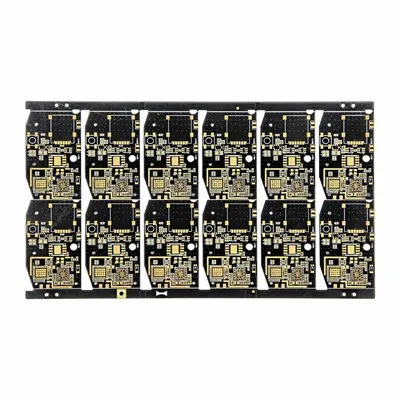
For protecting the PCB surface, we use solder mask. Solder mask is a layer that covers the PCB, except for the areas where we want to solder components. It’s usually green, but we can also get it in other colors like red, blue, or black. The solder mask not only protects the copper traces from oxidation but also helps prevent solder bridges during the soldering process.
Another important material is silkscreen. Silkscreen is used to print markings on the PCB. It shows things like component names, polarity indicators, and board edges. It’s like a map for the person who’s going to assemble or troubleshoot the PCB. We use a special ink for silkscreen printing that’s durable and won’t rub off easily.
When it comes to components themselves, we source them from all over the place. Resistors, capacitors, and inductors are the basic building blocks. Resistors are used to control the flow of current, capacitors store and release electrical energy, and inductors create magnetic fields. These components come in different values and packages. For example, for high – precision applications, we’ll use high – tolerance resistors. And for compact designs, we’ll go with surface – mount components that are smaller in size.
Integrated circuits (ICs) are also a huge part of our business. There are all kinds of ICs, from microcontrollers that can run complex programs to power management ICs that control the power supply to the PCB. These ICs can be very sensitive, so we have to be extra careful when handling and soldering them.
So, as you can see, there’s a whole bunch of materials that go into quick turn PCB assembly. Each one plays a crucial role in making sure the final product is reliable and performs well.
If you’re in the market for quick turn PCB assembly, I’d love to have a chat with you. Whether you’ve got a small project or a large – scale production need, we’ve got the know – how and the right materials to get the job done right. Reach out to me to start discussing your requirements.
Prototype PCB Assembly References
- Printed Circuit Board Handbook by C. F. Coombs, Jr.
- Electronic Components and Technology Conference Proceedings
Huaswin Electronics Technology Co., Ltd.
Address: Building A2, Hao Hai Hong Industrial Park, No.3 Yu He Road, Gong He, Sha Jing, Bao An, Shenzhen
E-mail: sales@huaswin.com
WebSite: https://www.huaswin-pcba.com/
